Key takeaways
- Wayflyer is a revenue-based financing provider designed for e-commerce and SaaS businesses, offering repayment tied to revenue.
- The best Wayflyer alternative depends on your business model. Some brands need revenue-based capital for ad spend, while others need funding aligned with inventory cycles.
- Many high-growth e-commerce sellers explore alternatives when scaling, because continuous repayment schedules don’t always align with inventory cycles or wholesale payments.
- Alternatives like Kickfurther match payment obligations to inventory sell-through, which better matches how e-commerce and CPG businesses generate cash.
- If your brand is scaling across Shopify, Amazon, or B2B wholesale, choosing the right financing structure can improve working capital efficiency, total cost of financing, and growth velocity.
- In 2026, the biggest shift in e-commerce financing is the move toward cash-flow-aligned funding models.
What is Wayflyer (and how does it work)?
Wayflyer is a revenue-based financing provider for DTC brands and e-commerce businesses. It gives sellers upfront capital—typically for ad spend, inventory, or growth initiatives—and collects repayment as a percentage of daily revenue.
Here’s the core structure:
- You receive a lump sum
- You repay through a fixed percentage of sales
- There’s a fixed fee instead of a traditional interest structure
- Repayment continues until the total amount is collected
This model is popular with:
- Shopify and WooCommerce brands
- SaaS and digital businesses
- High-growth e-commerce sellers running paid acquisition
It’s designed for speed and flexibility, but that flexibility comes with tradeoffs.
Why founders look for alternative forms of capital
Revenue-based financing solved a real problem when it emerged: getting capital fast, without giving up equity or waiting weeks for traditional underwriting. But as brands scale, the same structure that made it accessible can start to feel like a constraint. That’s when founders start looking at other options.
Here are the four most common reasons brands explore alternative forms of capital:
1. Cash flow pressure from continuous repayments
The thing with repayments is that they happen regardless of the revenue coming in. That can create pressure when:
- Inventory hasn’t sold yet
- Margins are tight
- Growth requires reinvestment
2. Misalignment with inventory cycles
Revenue-based models work best when revenue turns quickly. But most e-commerce and CPG brands deal with:
- 60–120 day production cycles
- Delayed wholesale payment terms
- Seasonal demand spikes
That creates a mismatch between when you pay and when you actually generate cash.
3. The ad spend vs. inventory tradeoff
Many founders use revenue-based financing to fund ads and then run into a bottleneck:
- Ads drive demand
- Inventory can’t keep up
- Cash gets pulled out before you can restock
4. Limited visibility into total cost
The “fixed fee” model sounds simple, but:
- Effective cost depends on repayment speed
- Faster growth can mean higher real cost
- Slower periods extend repayment timelines
For brands that hit these patterns, the next question is whether a different structure better matches how your business actually generates cash.
Financing options for e-commerce and B2B brands: pros and cons by category
The right financing option comes down to one question: what are you trying to fund, and when do you get paid back? Each model below answers that question differently.
1. Wayflyer (revenue-based financing)
A revenue-based financing provider that promotes fast capital, sometimes in as little as 24 hours. Repayment is collected as a percentage of daily revenue until the total amount (including fees) is paid back.
Pros:
- Fast funding
- Underwriting with minimal paperwork
- Repayment flexes with revenue
Cons:
- Continuous repayment pulls cash out daily
- Effective cost can rise if you grow quickly
- Built for ad spend more than inventory cycles
Best for: E-commerce brands funding paid acquisition with short revenue cycles.
2. Kickfurther (inventory funding)
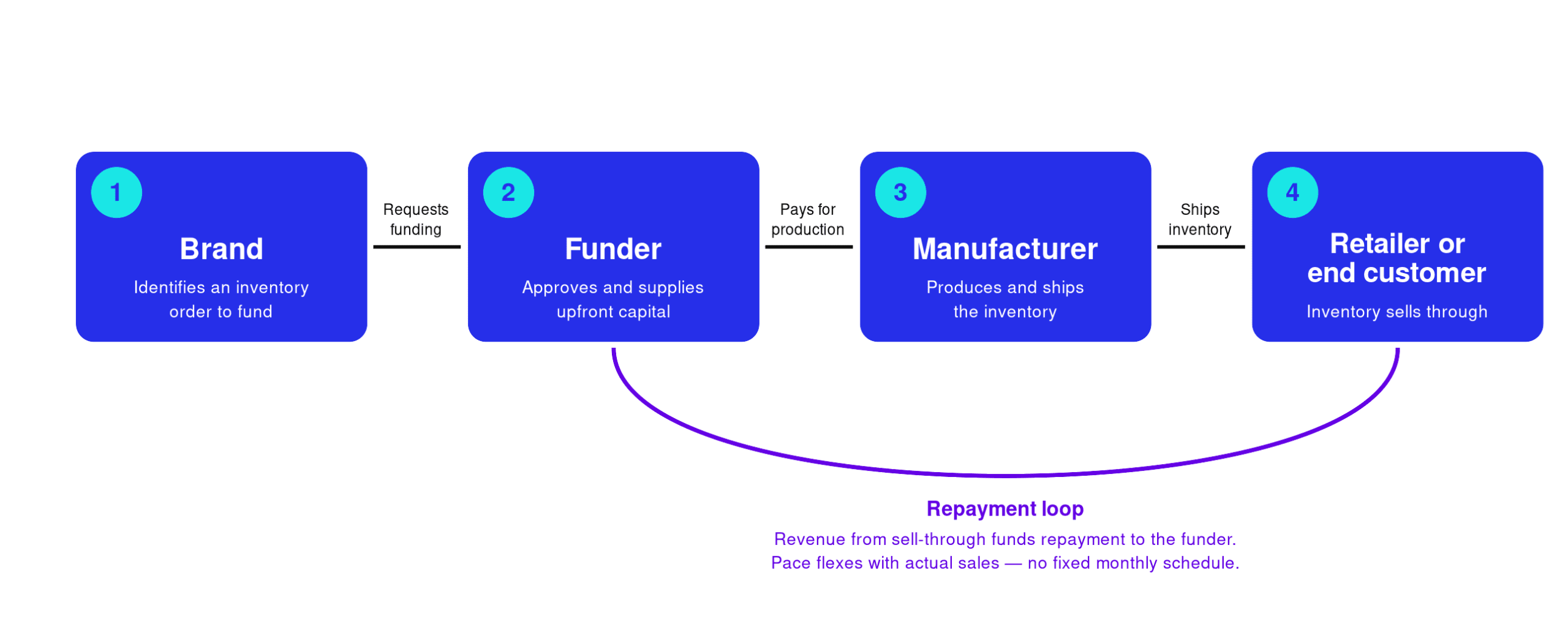
A marketplace-based model where inventory is funded upfront by a community of Buyers, and payments are owed when inventory sells. No fixed monthly payments—payment is tied to actual sell-through.
Pros:
- Payment aligned with sell-through, not daily revenue
- Working capital stays free for marketing and operations
- Scales with actual sales velocity and supports long production cycles
Cons:
- Requires demonstrated product demand
- Only suited for physical goods, not digital products or services
Best for: CPG and inventory-heavy e-commerce brands managing wholesale orders, seasonal inventory, or long production timelines.
3. Shopify Capital and Stripe Capital (platform financing)
Built-in financing is offered by platforms based on the merchant’s existing sales data. Repayment is automatically deducted as a percentage of sales.
Pros:
- Seamless integration with the platform
- Fast approvals based on existing sales data
- No separate application or underwriting
Cons:
- Only available to merchants on that platform
- Still uses revenue-based repayment
- Limited flexibility outside the platform ecosystem
Best for: Shopify-native or Stripe-native sellers who want frictionless funding tied to their existing sales data.
4. Clearco (revenue-based financing for marketing spend)
A revenue-based financing provider for DTC and e-commerce brands. As of late 2025, Clearco offers two products: Rolling Funding (ongoing capital you repay as you go) and Invoice Funding (covers time-sensitive vendor bills, including inventory orders, with capped weekly payments).
Pros:
- Built for scaling ad spend and paid acquisition
- Flexible repayment tied to revenue
- Fast approvals
Cons:
- Repayment is still tied to revenue rather than sell-through
- Capped weekly payments mean cash goes out on a schedule, not when stock sells
- Best fit is still growth and acquisition spend, even with inventory coverage added
Best for: Brands scaling paid acquisition that also want short-term coverage for vendor or inventory invoices.
5. Traditional lenders or line of credit
Bank loans and credit lines with fixed repayment schedules and traditional interest structures. Typically the lowest cost of capital for businesses that qualify.
Pros:
- Lower cost of capital for established borrowers
- Predictable repayment terms
- Builds business credit over time
Cons:
- Stricter qualification criteria for early-stage businesses
- Extensive documentation and underwriting requirements
- Fixed payments due regardless of business performance
Best for: Established brands with strong financials, predictable revenue, and the ability to manage a longer approval process.
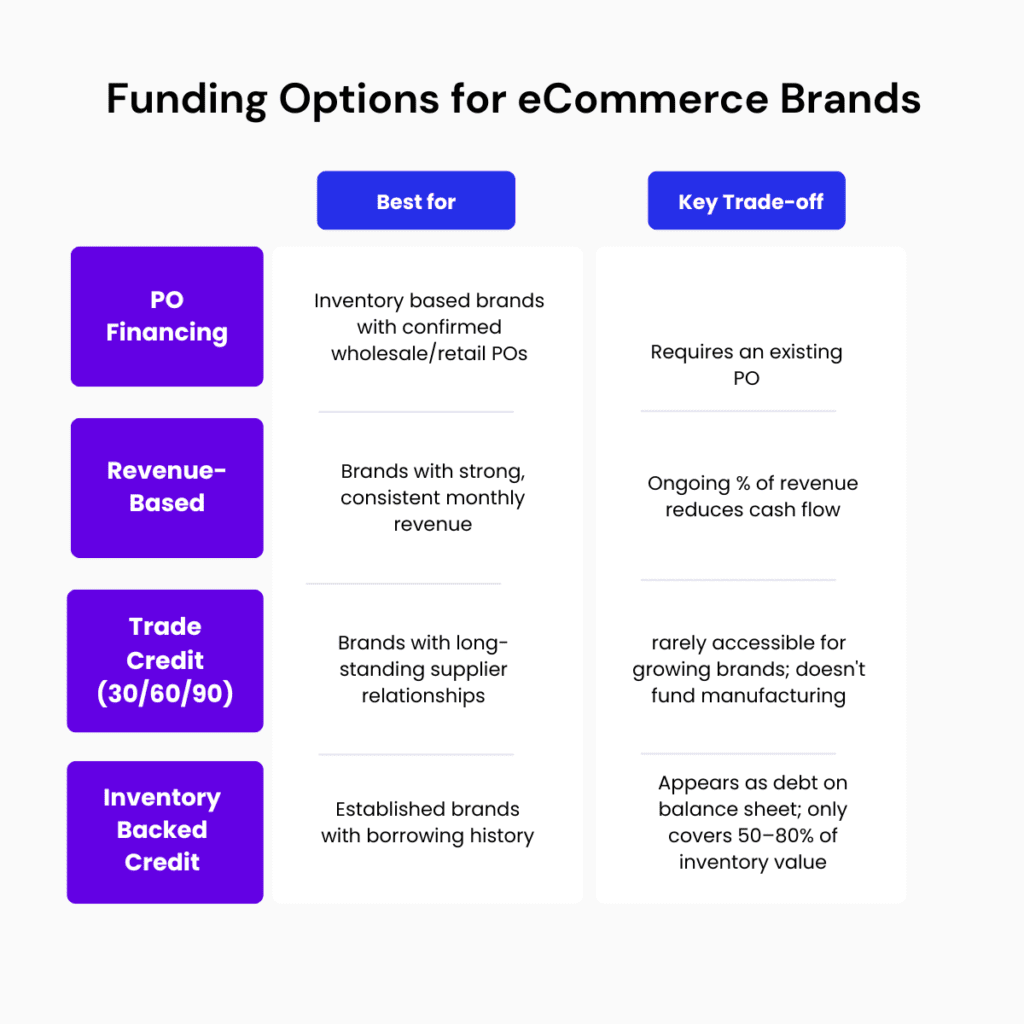
6. Purchase order financing
Funding tied to a specific confirmed order, typically a large wholesale or retail purchase order. The lender pays the supplier directly, and the brand repays from the resulting invoice.
Pros:
- Lets you fulfill orders larger than your cash on hand
- Risk is well-defined because it’s tied to a specific PO
- Can be approved quickly once the PO is verified
Cons:
- Transaction-specific, not ongoing working capital, requires a PO
- Less flexible for general operational needs
- Often higher cost than traditional credit lines
Best for: Brands with confirmed wholesale or distributor orders that need short-term funding to fulfill them.
7. Other alternatives: Capchase, 8fig, and Fundbox
Three other capital providers worth knowing about, each fitting a specific use case:
- Capchase: Revenue-based financing built for SaaS and subscription-based digital businesses. Advances future recurring revenue as upfront capital, with repayment tied to ongoing subscription income.
- 8fig: AI-powered e-commerce financing designed around supply chain planning, now owned by Bizcap (acquired late 2025) but operating under its own brand. Funding is delivered in installments aligned with cash flow needs, with repayment tied to sales.
- Fundbox: Business credit lines and invoice-based funding for small businesses. Offers quick capital decisions and fixed weekly payments over 12–24 month terms, though credit limits are typically smaller than other options on this list.
Best for: Capchase fits subscription businesses, 8fig fits e-commerce sellers planning supply chain spend, and Fundbox fits smaller, broader working capital needs.
For most CPG brands, the shift toward alternative funding happens when growth stops being about traffic and starts being about inventory velocity.
Comparing financing providers at a glance
| Option | Funding type | Repayment structure | Best for | Key limitation |
|---|---|---|---|---|
| Wayflyer | Revenue-based financing | % of daily revenue | Ad-driven e-commerce growth | Cash flow pressure |
| Kickfurther | Inventory funding | Pay as inventory sells | CPG & inventory scaling | Requires product demand |
| Shopify Capital | Platform financing | % of sales | Shopify sellers | Platform lock-in |
| Stripe Capital | Platform financing | % of payments | Stripe-native sellers | Platform lock-in |
| Clearco | Revenue-based financing | % of revenue | Paid acquisition scaling | Continuous repayment |
| Bank LOC | Credit line | Fixed schedule | Established businesses | Longer approval process |
| PO financing | Order-based funding | Paid from invoice | Wholesale orders | Requires a PO |
| Capchase | Revenue-based financing | % of recurring revenue | SaaS & subscription-based brands | Not for inventory-heavy businesses |
| 8fig | E-commerce financing | % of sales (installments) | E-commerce sellers planning supply chain | Still revenue-based repayment |
| Fundbox | Business credit line/invoice funding | Fixed weekly payments | Small business working capital | Lower credit limits |
Which financing model fits your business?
When comparing funding options, while speed and approval are important factors, repayment alignment is not to be overlooked.
Choose revenue-based financing (Wayflyer, Clearco, Stripe Capital) if:
- You’re funding ad spend or customer acquisition
- Your revenue cycles are short
- You can handle continuous repayment
Choose inventory-based funding (Kickfurther) if:
- You need to scale inventory or production
- Your cash is tied up in stock
- You want repayment aligned with sell-through
Choose traditional financing if:
- You qualify for low-cost capital
- You can manage fixed repayment schedules
- You can manage extensive documentation requirements and longer approval timelines
Wayflyer may be a fine financing option for e-commerce growth, but it’s not the right fit for every business model. As brands scale, the biggest constraint isn’t access to capital—it’s access to cash and how that capital is repaid.
The best Wayflyer alternative is the one that aligns with:
- Your inventory cycles
- Your cash flow timing
- Your growth strategy
Choosing the best funding partner in 2026: questions to ask
Before signing up for any funding option, run through these questions. They surface the issues that most often cause friction after the capital arrives.
1. What am I actually funding, and is the rest of my operation ready for it?
Funding ad spend without enough inventory creates demand you can’t fulfill. Funding inventory without a path to drive demand creates stranded capital. The capital and the operation need to match.
2. Will this repayment stack on top of obligations I already have?
Stacking multiple repayment structures can quietly compound. Even if each one is manageable on its own, the combined cash outflow can strain working capital.
3. Does the repayment schedule match when my business actually generates cash?
This is the question most founders skip. A 24–48 hour funding decision feels fast, but the repayment structure and costs run for months. Make sure the timing aligns with your inventory cycles, payment terms, and seasonal patterns.
4. Am I optimizing for speed of approval or fit with my business?
Fast approvals don’t fix misaligned financing. The best option isn’t always the one that can fund the fastest; it’s often the one that will still be able to fund you in a way that works six months from now.
FAQs
What is the best Wayflyer alternative in 2026?
The best Wayflyer alternative depends on your business model. For e-commerce brands focused on inventory and physical products, inventory funding like Kickfurther is often a better fit. For SaaS or digital businesses, revenue-based financing providers like Clearco or Stripe Capital may be more aligned.
How does Wayflyer repayment work?
Wayflyer uses a revenue-based repayment model, where a fixed percentage of daily or weekly sales is collected until the total repayment amount (including fees) is reached. This creates flexible repayment, but it can also reduce available cash flow during high-growth periods.
Why do e-commerce sellers explore alternatives to Wayflyer?
Many e-commerce sellers explore alternatives because:
- Continuous repayment schedules impact cash flow before inventory has converted to revenue
- Scaling requires reinvesting cash into stock, not repayments
- Total cost becomes less predictable when sales cycles are long or seasonal
Is revenue-based financing better than traditional business loans?
Revenue-based financing offers faster approvals, less paperwork, and flexible repayment tied to business performance. However, compared to traditional loans or lines of credit, it often has a higher total cost and can impact cash flow more frequently due to ongoing repayments.
What financing is best for e-commerce inventory?
For inventory-heavy e-commerce businesses, the best financing options are those that align repayment with inventory sales, not revenue collection. Inventory funding models allow brands to stock products, scale production, and pay only as items sell—reducing cash flow strain.
Can I use Wayflyer and another funding partner at the same time?
Yes, many businesses use multiple financing options (for example, revenue-based financing combined with inventory funding). However, combining providers can create overlapping repayment obligations, which may strain working capital and reduce flexibility.
How does Wayflyer compare to Shopify Capital and Stripe Capital?
All three use revenue-based financing, which means they share similar cash flow dynamics. The main differences:
- Wayflyer is a standalone e-commerce provider with flexible revenue-based repayment
- Shopify Capital is built into the Shopify ecosystem and limited to platform users
- Stripe Capital is integrated with Stripe payments and follows a similar repayment structure
What is the difference between revenue-based financing and inventory funding?
Revenue-based financing collects a percentage of sales continuously, regardless of what the capital was used for. Inventory funding aligns payment specifically with product sell-through, making it more suitable for physical goods businesses with longer sales cycles.
Is Wayflyer a fit for early-stage startups?
Wayflyer can work for early-stage e-commerce startups with strong revenue traction, especially those investing heavily in ad spend. However, startups with limited cash flow or long inventory cycles may find a better fit with alternative financing options.
What should I look for in a Wayflyer alternative?
When evaluating alternatives, focus on:
- Repayment timing (does it match your cash flow?)
- Total cost and fee transparency
- Speed of funding (24–48 hours vs. longer approvals)
- Flexibility for scaling (inventory vs. marketing vs. working capital)
- Impact on operations and growth