This post was last updated on June 9, 2026, by our partners at Bridge; the original post was published on Oct. 20, 2021.
Retailers, wholesalers, and seasonal businesses often turn to inventory financing when they need to meet demand without disrupting cash flow. But traditional inventory financing isn’t always easy to qualify for, and it’s not always the right fit. The good news is there are several inventory financing alternatives and financing options worth knowing before you commit to any one path.
Quick answer
Beyond traditional inventory financing, product brands have five alternatives worth comparing: purchase order financing, crowdfunding and consignment marketplaces, bank loans, a business line of credit, and personal loans. The best financing option depends on where in your production and sales cycle you need capital, how strong your credit history is, and whether you have a committed buyer.
To qualify for most types of inventory financing, businesses should have at least one year in business, a sales history, and a reliable inventory management system. But depending on your stage and business model, one of the financing solutions below may be a better match than standard inventory financing alone.
What are financing alternatives to fund inventory expansion needs?
Businesses need access to capital in order to grow. Even well-established, profitable small businesses can find themselves cash-constrained when it’s time to build inventory. The right financing option depends on where in your production and sales cycle you need capital, how strong your credit history is, and whether you have a committed buyer or are building inventory speculatively. Let’s explore five inventory financing alternatives that can fund your expansion needs.
| Financing option | How it works | Best for | What underwriting looks at |
|---|---|---|---|
| Purchase order financing | Funds production against a confirmed retail PO, often up to 100% of COGS, paid to your supplier | Brands with confirmed retail orders they can’t produce on their own | The purchase order and the retailer’s credit, not yours |
| Crowdfunding / consignment | Pools capital from many backers; with Kickfurther, Buyers fund inventory on consignment and you pay as it sells | Brands with an engaged community building inventory ahead of a launch | Your product and sales channel |
| Bank loan | A lump sum repaid in fixed monthly payments at a set interest rate | Established businesses with strong credit and clear inventory needs | Your credit score, collateral, and time in business |
| Business line of credit | Revolving capital you draw and repay as needed; you pay interest only on what you use | Recurring or seasonal inventory cycles that need flexibility | Your business credit history |
| Personal loan | Personal financing applied to business inventory; no collateral, but higher rates | Early founders without business credit, as a short-term bridge | Your personal credit score |
Purchase order financing
Purchase order financing is one of the most relevant inventory financing alternatives for product brands selling into major retail. Rather than borrowing against stock you already have, PO financing funds the production of inventory you’ve been ordered to make.
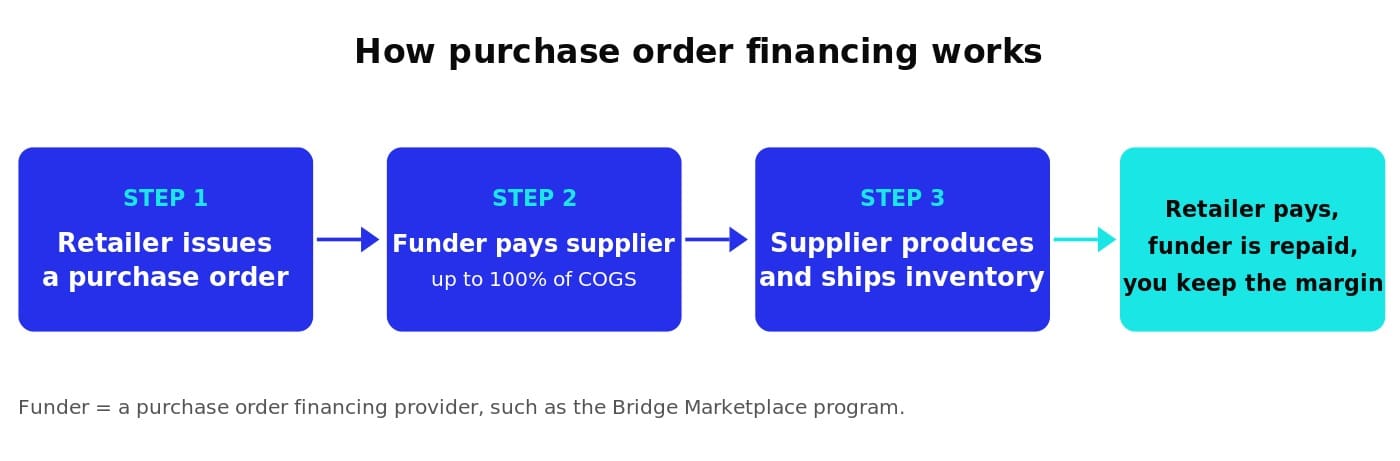
Here’s how it works:
- A retailer issues you a purchase order
- You don’t have the capital to produce and ship it.
- A PO lender funds your cost of goods, often up to 100%, directly to your supplier or co-packer.
- When the retailer pays, the lender is repaid and you keep the margin.
 Unlike most small business loan products, PO financing decisions are based primarily on the strength of the purchase order and the creditworthiness of the retailer, not your own credit score or business credit history. That makes it accessible to younger brands that have landed significant retail placements but don’t yet have the track record to qualify for traditional financing.
For Walmart and Sam’s Club suppliers specifically, Bridge runs the official Purchase Order Financing Program for both retailers. Bridge funds up to 100% of COGS so suppliers can produce and ship without draining operating cash. Suppliers share their PO and basic financials, receive loan terms within 48 hours, and get funded the same day approval comes through. Kickfurther is proud to be one of the funding partners selected to underwrite financing requests on the Bridge platform.
PO financing is worth exploring if you have confirmed retail orders you can’t produce without outside capital. It’s not a fit for speculative inventory builds or businesses without a committed buyer.
Crowdfunding
Small businesses can raise money for inventory expansion using crowdfunding. Individuals and organizations create campaigns that backers or buyers choose to support. Crowdfunding pools together capital from multiple contributors, which can add up quickly without taking on a traditional small business loan.
Kickfurther takes a different approach: a marketplace where Buyers purchase inventory on consignment. You get the capital to purchase inventory without giving up equity, and payments align with when your inventory actually sells rather than on a fixed schedule. Most crowdfunding platforms charge fees for raising funds, so it’s worth factoring that into your cost of capital calculations.
Crowdfunding tends to work best for brands with an engaged community or a compelling product story. It requires marketing effort to run a successful campaign, and results aren’t guaranteed. For brands that need to move quickly on a confirmed order, it’s usually too slow. But for building new inventory ahead of a launch or retail pitch, it can be a cost-effective alternative to debt.
Bank loans
Bank loans provide small business owners with a lump sum that can be used to purchase inventory or cover general business financing needs. In some cases, the application process can take one to three months to complete, which makes them a poor fit for time-sensitive inventory needs.
Qualifying for a small business loan can be challenging for newer companies. Banks typically require collateral or a personal guarantee, along with a solid credit history, documented time in business, and proven sales. Your credit score plays a meaningful role in what rates and terms you can access. Lenders will also evaluate the value of your inventory and other assets when assessing collateral.
If you do qualify, bank loans generally offer competitive fixed interest rates with predictable monthly payments, making them one of the lower-cost inventory financing options for established businesses. For brands with strong business credit and a clear picture of their inventory needs, a term loan can be one of the most straightforward financing solutions available.
Business line of credit
A business line of credit gives you revolving access to a set amount of capital that you can draw and repay as needed. It’s typically issued by a bank or credit union and carries a lower interest rate than a credit card.
A business line of credit works well for managing recurring inventory cycles, seasonal builds, and situations where you need flexibility rather than a lump sum. If you have an $80,000 business line of credit and use $50,000 of it, you have access to the remaining $30,000 until you repay what you borrowed. Once repaid, your full limit is available again.
One advantage of a business line of credit over a term loan is that you only pay interest on what you draw, not the full limit. That makes it a more efficient financing option for businesses with variable inventory needs from month to month. Qualification requirements are similar to bank loans, and your business credit history will be a key factor in the limit and rate you’re offered. Newer businesses may find them difficult to access until they’ve built a stronger credit track record.
Personal loans
Personal loans are sometimes used by small business owners and startup entrepreneurs who haven’t yet qualified for business credit. They don’t require collateral and are generally accessible even for borrowers with a limited credit history or less-than-perfect personal credit.
The tradeoff is cost. Compared to bank loans, a business line of credit, or purpose-built funding platforms like Kickfurther, personal loans tend to carry higher interest rates. They’re best treated as a short-term bridge rather than a long-term inventory financing solution, and mixing personal credit with business finances can create complications as your business grows. If you’re relying on personal credit to fund inventory needs, it’s worth treating that as a signal to shore up your business credit profile so you can access better options over time.
What is the least costly way to finance inventory?
In most cases, a bank loan, business line of credit, or a structured platform like purchase order financing will be the most cost-effective path. If your business supplies major retailers like Walmart and you’re working from a confirmed purchase order, PO financing through a program like Bridge is often the most efficient structure because it’s purpose-built for that cash gap. Paying cash remains the cheapest option when it’s available, but most growing small businesses need outside capital to purchase new inventory without disrupting operations.
Which type of financing is most appropriate to finance the purchase of inventories?
It depends on your business model and inventory needs. If you turn inventory quickly and need ongoing flexibility, a business line of credit may be your best fit. If you have a large confirmed order from a retail partner and need to fund production, purchase order financing is often the most direct solution. If you’re an emerging brand without the credit history to qualify for traditional lending, consignment-based funding through a platform like Kickfurther can align capital with how your inventory actually sells.
How does your credit history affect your financing options?
Most traditional inventory financing options, including bank loans and business lines of credit, rely heavily on your credit score and credit history during underwriting. Strong business credit typically unlocks lower rates, higher limits, and more flexible terms. Weak or limited credit history narrows your options and raises your cost of capital.
The good news is that not every inventory financing alternative is credit-driven. Purchase order financing, for example, is underwritten primarily against the purchase order itself and the retailer’s payment history rather than your personal credit or business credit score. Consignment-based models like Kickfurther evaluate the product and sales channel more than traditional creditworthiness. Building your business credit over time remains important, but it doesn’t have to be a blocker while you’re still early.
Grow your business with Kickfurther
Kickfurther has proven to be a flexible inventory financing platform for growing small businesses. Our customers often see lower costs than what’s available elsewhere and access payment terms that offer superior flexibility. Whether you’re exploring crowdfunding, PO financing, or a traditional credit product, understanding your financing options is the first step toward choosing the right one.