Cash flow pressure in Consumer Packaged Goods (CPG) and eCommerce businesses often results from inventory decisions made at the wrong time, in the wrong quantity, or without financial context.
When inventory management operates separately from financial statements, businesses either overstock and lock up working capital or understock and lose revenue momentum. In both situations, the problem is usually the lack of connection between inventory decisions and the P&L numbers.
This guide shows you how to connect your financial statements to inventory planning, so inventory decisions strengthen cash flow rather than quietly drain it.
Why should you connect financial statements to inventory decisions?
You should connect the two because your financials tell you exactly what you can afford to buy, which products are worth restocking, and when you’re about to run out of cash.
Without that connection, you’re guessing. And guessing is expensive. Inventory distortion (stockouts plus overstock) costs global retailers $1.73 trillion in 2025, according to IHL Group. Yet 34 percent of SMBs still track inventory manually or not at all.
When you connect your financials to your inventory decisions, you buy the right products in the right quantities. You avoid tying up cash in stock that won’t move. You know when you have room to order more and when you don’t.
Then, you can plan your financing around your actual cash position instead of reacting to a crisis.
How to read your P&L before you place purchase orders
Your P&L should answer one question before any major order: do we have the margin and momentum to support this buy?
Here’s what to look at:
- Gross margin: A healthy eCommerce range sits between 45 and 70 percent. According to NYU Stern data, general retail averages 33.18% and specialty retail 35.30%. If your margin is healthy and stable, you have room to invest in inventory. If it’s declining, find out why before placing another order.
- COGS as a percentage of revenue: Should stay consistent month over month. An unexplained increase of more than 2 to 3 percent signals rising input costs, freight changes, or a product mix shift toward lower-margin items.
- Operating cash flow: Positive net income doesn’t mean cash is available. If your P&L shows a profit but your cash flow statement shows negative operating cash flow, money is locked in inventory or receivables. Adding more stock in that position compounds the problem.
One practical framework that ties your P&L data directly to purchasing is Open-to-Buy (OTB) planning.
It tells you exactly how much new inventory you can afford to buy in a given period without overextending your cash.
The formula is:
OTB = Planned Sales + Planned Markdowns + Planned End-of-Month Inventory – Beginning-of-Month Inventory
Say you’re planning $50,000 in sales next month, expect $2,000 in markdowns, want $10,000 of inventory left at month’s end, and you’re starting with $20,000 already in stock.
Your OTB is $42,000. It means that’s the maximum you should spend on new inventory this month.
If your planned sales drop to $30,000, your OTB shrinks to $22,000.
That’s the point. It turns your financial data into a hard purchasing limit instead of a loose guideline.
Stop and wait before placing a large PO (purchase order) if you see gross margin declining, COGS growing faster than revenue, or inventory levels rising faster than sales velocity.
For eCommerce sellers building this habit from scratch, EcomBalance offers monthly bookkeeping that ensures your P&L is clean, current, and ready to guide every purchasing decision.
Ways to turn gross margin insights into smarter inventory allocation
Gross margin tells you how profitable a product is. But to make smarter inventory decisions, you need to know which products are worth putting your money behind and how much.
Two frameworks help with this:
Use GMROI to compare products fairly
Gross Margin Return on Investment (GMROI) tells you how much gross profit you earn for every dollar invested in inventory.
GMROI = Gross Profit ÷ Average Inventory Cost
A GMROI above 1.0 means you’re making money on that stock. Target above 3.0. Use it to compare products directly and allocate more budget to what’s working hardest.
Rank your products with ABC analysis
Once you know your GMROI by product, ABC analysis helps you act on it:
- A products (20% of SKUs, 80% of gross profit): Stock aggressively. These are your priorities.
- B products (30% of SKUs, 15% of gross profit): Maintain, but don’t over-invest.
- C products (50% of SKUs, 5% of gross profit): Cut back or clear out. They’re tying up cash without contributing much.
Also, watch for any product that hasn’t sold in 90 days. The longer slow-moving stock sits, the more it costs you in storage, insurance, and tied-up cash. Clear it out before it becomes a liability.
How to fund purchase orders without straining cash flow
Even with clean financials and solid purchasing decisions, there’s still a timing problem. You may pay for inventory months before revenue comes back.
The typical CPG cycle:
- Pay manufacturer’s deposit.
- Wait 60 to 120 days for production and shipping.
- Hold inventory for 30 to 60 days.
- Then sell to a retailer on Net 60 terms.
That’s a cash conversion cycle of 150 days or more, with your cash locked up the entire time. 82 percent of small business failures involve cash flow problems.
Here are some common funding options to bridge that gap:
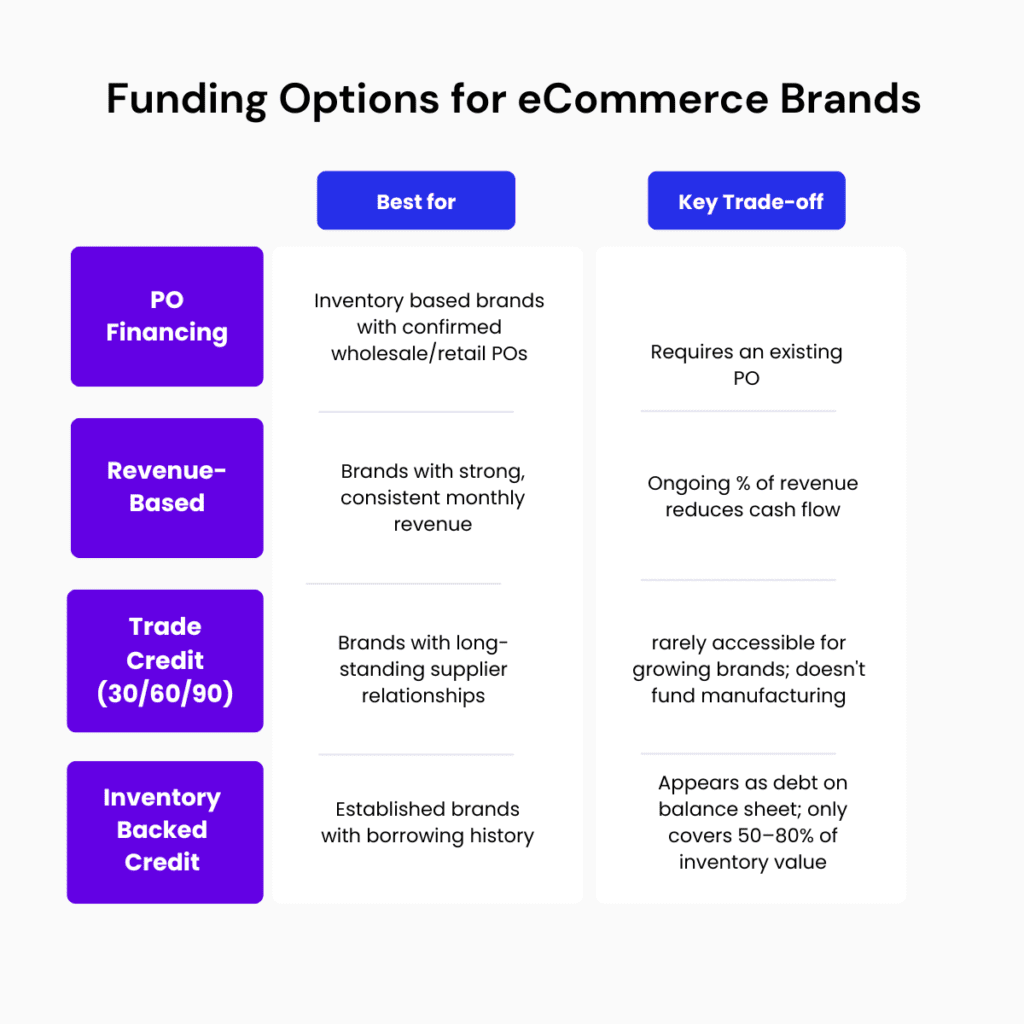
One option worth knowing specifically for CPG brands is Kickfurther’s Co-Op model. Rather than taking on debt or diluting ownership, Kickfurther connects brands to a community of marketplace buyers who offer inventory financing on a consignment basis.
Brands access $20,000 to $1,000,000 per order, and payment only starts as inventory sells. Because it’s structured as consignment, there’s no debt added to your balance sheet and no equity given up.
If cash flow is holding back your next order, see how Kickfurther works for CPG brands and check if your brand qualifies.
Common mistakes to avoid when you connect financials and inventory
Connecting your P&L to your purchasing decisions reduces risk, but only if you avoid the following patterns that can undermine the whole system:
- Ordering based on instinct instead of data: Gut feel is how dead stock gets created. Funko Pop over-ordered collectibles in 2022 and destroyed over $30 million in product in 2023.
- Booking inventory directly to COGS at purchase: Under accrual accounting, inventory is a balance sheet asset until it sells. Expensing it at purchase makes your P&L unreliable as a planning tool.
- Ignoring COGS at the SKU level: Blended margins hide a lot. A brand can show a 45 percent overall margin while individual SKUs run at 18 percent. Know your numbers per product.
- Skipping inventory reconciliation: When physical counts don’t match your records, COGS is wrong, margins are wrong, and your P&L can’t guide purchasing decisions.
- Mixing up profit and cash flow: A profitable P&L doesn’t mean cash is available. Amazon holds payouts for days or weeks after a sale is recorded. Always check your cash flow statement before placing an order.
Tools and systems that connect accounting, inventory, and cash flow forecasting
Once your purchasing decisions are grounded in your financials, you need systems that keep that data accurate and connected at all times.
Here are the key tools that help:
- QuickBooks Online and Xero: The standard accounting platforms for eCommerce. Both produce the P&L, balance sheet, and cash flow reports you need and integrate with most inventory tools.
- A2X: Syncs sales, fees, and COGS from Amazon, Shopify, and other marketplaces directly into QBO or Xero automatically.
- Cin7 Core: Built for multi-channel brands with 50 or more SKUs. Two-way sync with QuickBooks and Xero keeps inventory and accounting data aligned.
- Inventory Planner: AI-driven purchasing recommendations at the SKU level for inventory demand forecasting and OTB planning.
All of these tools are only as good as the books behind them. A dedicated eCommerce bookkeeping service ensures your financial data is accurate, closed on time, and ready to act on.
Final thought
Getting your financials and inventory in sync is one thing. Having the cash to act on what your numbers are telling you is another.
That’s where Kickfurther comes in. We help CPG and eCommerce brands fund inventory without taking on debt or giving up equity. You get up to $1,000,000 per order and pay nothing until your inventory sells. Many Co-Ops fund within 24 hours.
Stop letting cash flow hold back your next order. Schedule a call with our team and let’s talk.
Frequently asked questions (FAQs)
Below are a few common questions about connecting financials to inventory planning:
What financial metrics should guide purchase orders?
The core metrics: inventory turnover ratio (target four to six times per year), Days Inventory Outstanding (DIO), Cash Conversion Cycle (CCC), gross margin by SKU, GMROI, and current ratio (1.2 to 2.0 before committing to a large order).
Simplify your purchase order process by keeping these numbers clean, current, and easy to act on.
How often should I review financials before I place orders?
At a minimum, go through your full P&L, balance sheet, and cash flow statement every month. Try to close your books by the 15th so you have clean data before you make any buying decisions that month.
Before any major PO, check current cash, outstanding payables, and expected inflows over the next 60 to 90 days. Two to three months before peak season, run a full demand forecast.
Can better inventory decisions improve cash flow?
Yes, and faster than most founders expect. When you stop over-ordering slow sellers, that cash is freed up immediately. Preventing stockouts on your best products means you stop losing sales to competitors.
Also, when you improve your inventory turnover from three to six times per year, you cut the time your money is sitting on a shelf in half.
About the Author: This blog post was contributed by our partner EcomBalance, the go-to bookkeeper for eCommerce businesses.