
Wayflyer is one of the better-known financing providers for online retailers, but it isn’t the right structure for every business. This guide compares the strongest alternatives to Wayflyer for e-commerce brands, marketplace sellers, and B2B wholesale operators, and shows you how to match a funding partner to the way your business actually generates cash.
Key takeaways
- Wayflyer provides capital to e-commerce businesses and DTC brands, with repayment collected as a percentage of sales.
- The best alternative depends on your business model. Some brands need capital for marketing. Others need funding aligned with inventory cycles.
- A seller explores alternatives when continuous repayment starts pulling cash out faster than inventory converts.
- Kickfurther matches payment obligations to inventory sell-through, which fits how CPG and inventory-heavy brands generate cash.
- Cost, qualification terms, and pricing model vary widely between financing options, even when headline fees look similar.
What is Wayflyer and how does it work?
Wayflyer is a revenue-based financing provider built for e-commerce and DTC brands. It gives sellers upfront capital and collects repayment as a percentage of daily sales until the funded amount plus a flat fee is paid.
The structure works like this:
- You receive a lump sum shortly after approval.
- You repay through a percentage of sales, so the amount is tied to sales volume.
- Wayflyer charges a fixed fee instead of a traditional interest structure.
- Collection continues until the full amount is recovered.
Wayflyer offers funding to Shopify and WooCommerce brands, online retailers, and SaaS businesses. Its fee typically falls between 5 and 10 percent of the advance, with no origination or maintenance charges.
The platform includes a merchant dashboard with analytics tools that track daily sales and marketing performance. That visibility is a real strength. The tradeoff is that repayment tied to sales runs continuously, whether or not your stock has turned.
Why are sellers looking for funding elsewhere?
Brands look for alternatives when the repayment structure stops matching their cash cycle, not because the capital itself is a problem.
Revenue-based financing solved something real when it emerged: fast access to funds without giving up equity or waiting weeks on traditional lenders. But as brands scale, the same structure that made it accessible can start to bind.
Continuous collection pressures cash runway
Payments come out regardless of what’s coming in or what inventory was funded with the money. That creates strain when inventory hasn’t sold, margins are tight, or growth requires reinvestment. A healthy cash position on paper can still feel thin when a percentage of every sale is leaving daily.
Misalignment with inventory cycles
Revenue-share models work best when revenue turns quickly. Most consumer product brands deal with 60-120 day production cycles, lengthy payment terms, and seasonal demand spikes. That creates a gap between when you pay and when you actually collect.
The marketing versus inventory tradeoff
Founders often use growth funding for paid acquisition, then hit a wall. Ads drive demand, inventory can’t keep up, and cash gets pulled out before they can restock.
Limited visibility into what it actually costs
A flat fee sounds simple. But the effective cost depends entirely on how fast you repay. Grow quickly and the annualized figure climbs. Slow down and the timeline stretches.
The best alternatives to Wayflyer in 2026
The right option comes down to one question: what are you funding, and when does the money come back? Each model answers that differently, and each fits different use cases.
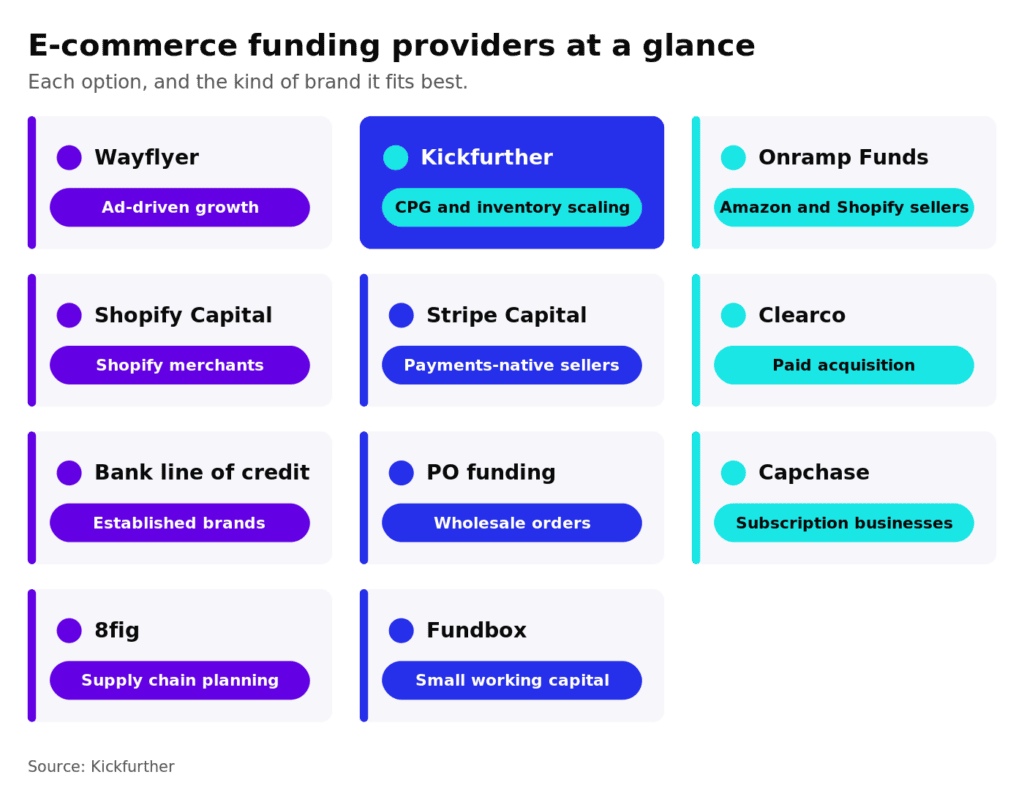
Kickfurther: inventory funding for consumer product brands
Kickfurther is a consignment-based marketplace where Brands get inventory funded upfront by a community of Buyers. Buyers choose which consignment opportunities (Co-Ops) they’d like to fund, and the Brand makes payments as that inventory sells. There are no fixed monthly obligations tied to a calendar.
Pros: Payments follow actual sales, not a fixed calendar. Working capital stays free for marketing and operations. Supports long production timelines and large wholesale orders.
Cons: Requires demonstrated product demand and sales history. Physical goods only, not digital products or services.
Best for: CPG and inventory-heavy brands managing wholesale orders, seasonal inventory needs, or long lead times.
Brands can come back and fund SKUs based on demand. Spongelle, for example, is over 12 Co-Ops strong with over $4M in inventory funding (and counting).
Onramp Funds: revenue-based financing for marketplace sellers
Onramp Funds is one of the few providers that specialize in US e-commerce merchants only. It focuses exclusively on that segment and leans on store performance rather than personal credit. A seller connects their store, and Onramp generates uncapped offers based on sales data.
The provider offers both variable and fixed structures, with a flat fee reported in the 2 to 8 percent range and no personal guarantee or collateral required. It supports Amazon, TikTok Shop, WooCommerce, BigCommerce, Walmart, and Stripe, with a $10,000 average monthly sales threshold.
Pros: Approval runs on store performance, not your personal credit file. Funding can land within 24 hours. You choose variable payments or fixed installments.
Cons: The flat fee’s real cost climbs the faster you repay. Payments still follow sales rather than inventory sell-through. It’s geared to online sellers, so wholesale-heavy brands may not qualify.
Best for: A seller on Amazon or Walmart who wants capital based on store data and prefers founder-friendly terms.
Shopify Capital and Stripe Capital: embedded lending for platform sellers
These are embedded lending products, offered inside a platform you already use, underwritten from sales data you’ve already generated. Shopify Capital provides funding directly inside the admin, and the Stripe product works the same way through payments data.
Pros: No separate application, and a seamless approval flow inside a dashboard you already use.
Cons: Available only to merchants on that platform. Still collects continuously. Offers are pushed to you rather than requested, so timing may not match your inventory needs. Lender sits ahead of you on the payment stream.
Best for: Platform-native sellers who want frictionless access to funds.
Clearco: growth funding for high-growth DTC brands
Clearco specializes in providing growth capital to consumer brands. It targets DTC and e-commerce sellers with two products: Rolling Funding, an ongoing line you draw against, and Invoice Funding, which covers time-sensitive vendor bills including inventory orders.
Pros: Built for scaling ad spend. Fast decisions. Flexible repayment tied to revenue.
Cons: Collection is still tied to sales rather than sell-through. Capped weekly payments mean cash leaves on a schedule, not when stock moves.
Best for: Brands scaling paid acquisition that also want short-term coverage for vendor invoices.
Traditional lenders and lines of credit
Bank credit lines carry the lowest cost of capital for businesses that qualify, with predictable repayment schedules and a real interest rate rather than a fee.
Pros: Cheapest capital available. Builds business credit. Terms are transparent and regulated.
Cons: Stricter criteria, heavy documentation, and a longer timeline. A lender will usually require a personal guarantee. Fixed payments are due regardless of business performance.
Best for: Established brands with strong financials and time to work through underwriting.
Purchase order and invoice funding
Purchase order funding is tied to a confirmed wholesale order. The provider pays your supplier directly, and you settle from the resulting invoice. Invoice funding works in reverse, advancing against receivables you’ve already billed.
Pros: Lets you fulfill orders larger than your cash on hand. Risk is well defined because it’s tied to a specific order or invoice.
Cons: Requires a purchase order or sent invoice. Transaction-specific rather than ongoing working capital. Often costs more than a credit line.
Best for: Brands with confirmed distributor or retail orders.
Other options include Capchase, 8fig, and Fundbox
Three more providers worth knowing:
- Capchase advances future recurring revenue for SaaS and subscription businesses.
- 8fig offers AI-powered e-commerce financing built around supply chain planning, delivered in installments.
- Fundbox provides credit lines and invoice-based microloans for smaller businesses, with fixed weekly payments and lower limits than others here.
Comparing financing solutions at-a-glance
| Provider | Funding type | How you pay it back | Best for | Key limitation |
|---|---|---|---|---|
| Wayflyer | Revenue-based | Percentage of sales | Ad-driven growth | Continuous cash outflow |
| Kickfurther | Inventory funding | As inventory sells | CPG and inventory scaling | Requires product demand |
| Onramp Funds | Revenue-based | Variable or fixed remittance | Amazon and Shopify sellers | Geared to online sales |
| Shopify Capital | Platform financing | Share of sales | Shopify merchants | Platform lock-in |
| Stripe Capital | Platform financing | Share of payments | Payments-native sellers | Platform lock-in |
| Clearco | Revenue-based | Percentage of revenue | Paid acquisition | Capped weekly payments |
| Bank line of credit | Credit line | Fixed schedule | Established brands | Slow to close |
| PO funding | Order-based | From the invoice | Wholesale orders | Requires a purchase order |
| Capchase | Revenue-based | Share of recurring revenue | Subscription businesses | Not for physical goods |
| 8fig | Ecommerce financing | Installments tied to sales | Supply chain planning | Still sales-linked |
| Fundbox | Credit line / invoice | Fixed weekly payments | Small working capital needs | Lower limits |
What do funding providers actually require to approve you?
Qualification varies more than headline marketing suggests, and the differences directly impact who can realistically use each option.
Most revenue-based providers underwrite from platform data rather than credit files. They connect to your store, review 3-6 months of sales history, and generate an offer, sometimes with uncapped offers that scale as you grow. A decision can land in a day or two.
The personal guarantee question matters most. Wayflyer and Onramp both state they don’t require one. Banks almost always do. Some providers that advertise no PG still file UCC liens on business assets, which isn’t the same thing as no recourse.
Read what you’re signing. A UCC filing, a fund redirection clause, or a confession of judgment provision each carry real consequences.
What does ecommerce financing really cost?
The advertised fee is rarely the full picture, because a flat percentage says nothing about time.
Consider a $50,000 advance at an 8 percent fee. Repaid over 12 months, that’s roughly an 8 percent annualized cost. Repaid in 90 days because sales moved faster than expected, the same fee annualizes north of 30 percent. Effective APRs across revenue-based products commonly land between 10 and 60 percent depending on speed.
Watch for hidden fees in three places: origination charges buried in the agreement, minimum remittance floors that accelerate collection during slow months, and renewal terms that roll an unpaid balance into new funding at a fresh fee.
Ask every provider for the total dollar amount you’ll pay back and the expected timeline. Two offers with identical fee percentages can differ by thousands once you model the actual cash out.
How do you choose the right funding partner?
Match the structure to your cash cycle first, then compare cost.
- Choose revenue-based financing (Wayflyer, Onramp, Clearco, Shopify Capital) if you’re funding marketing, your sales cycles are short, and you can absorb continuous collection. This suits dropshippers and any digital-first seller whose cash converts in days.
- Choose inventory funding (Kickfurther) if your cash is tied up in stock, you’re funding production or a wholesale order, and you need payments aligned with sell-through rather than daily receipts.
- Choose a traditional line of credit if you qualify, want the lowest cost, and can manage documentation and a longer timeline.
Wayflyer works well for e-commerce growth. It’s just fundamentally different from inventory funding, and the gap shows up when your cash is sitting in a container rather than in your bank account.
Questions to ask before you sign
- What am I funding, and is the rest of my operation ready? Funding marketing without enough inventory creates demand you can’t fill. Funding inventory without demand creates stranded stock.
- Will this stack on obligations I already have? Multiple structures compound quietly. Each may be manageable alone; combined, they strain working capital.
- Does the collection schedule match when I actually generate cash? A fast decision feels good but, if it doesn’t match your payment cycle, it can cripple the business.
- Am I optimizing for speed or for fit? Faster approvals don’t fix a mismatched structure, and the total cost of a bad fit compounds.
Final things to consider
- Structure matters more than speed. A 24-hour decision doesn’t help if the collection schedule fights your cash cycle.
- The fee isn’t the cost. Annualize it against your realistic timeline.
- Match funding to what you’re buying. Marketing spend and inventory have different payback profiles.
- Check the qualification fine print. No PG doesn’t always mean no recourse.
- For inventory-heavy brands, sell-through alignment is the differentiator. That’s the gap Kickfurther is built to close.