
As Kickfurther’s CEO, I’ve watched thousands of startup founders and growing consumer brands wrestle with the same question: how do you raise capital without giving up equity?
This guide to non-dilutive funding breaks down the most common non-dilutive funding options available to startups and growth-stage businesses today. We’ll cover how non-dilutive funding works, the different types of non-dilutive financing available, when each option makes sense, and how founders can access capital without giving up equity or sacrificing long-term ownership.
Quick answer
Non-dilutive funding is capital you access without giving up equity in your company. The main types include grants, venture debt, revenue-based financing, invoice factoring, purchase order financing, inventory funding, rewards-based crowdfunding, and bootstrapping. Each one has trade-offs around cost, eligibility, and how repayment works.
What is non-dilutive funding?
Non-dilutive funding is any form of capital you bring into your business without surrendering ownership. You don’t give up shares. You don’t add equity investors to your cap table. The percentage of the company you own stays the same after the funding as before. The term is often used interchangeably with ‘non-dilutive financing’.
That’s the simple definition. But here’s the part founders sometimes miss: non-dilutive doesn’t mean “no obligation.” Most non-dilutive vehicles have repayment terms, fees, or a cost of capital attached. The trade-off you’re making isn’t between paying and not paying. It’s between giving up equity (forever) and paying for capital in some other way.
What non-dilutive funding is not: equity or convertible debt financing of any kind. That includes priced rounds, convertible notes, and SAFEs. Convertible notes and SAFEs feel non-dilutive at first because no shares move on day one, but they convert into equity at the next round, so they’re really just deferred dilution. I’ll come back to that in the FAQs.
Why are founders choosing non-dilutive funding right now?
Three reasons keep coming up in conversations with the founders we work with.
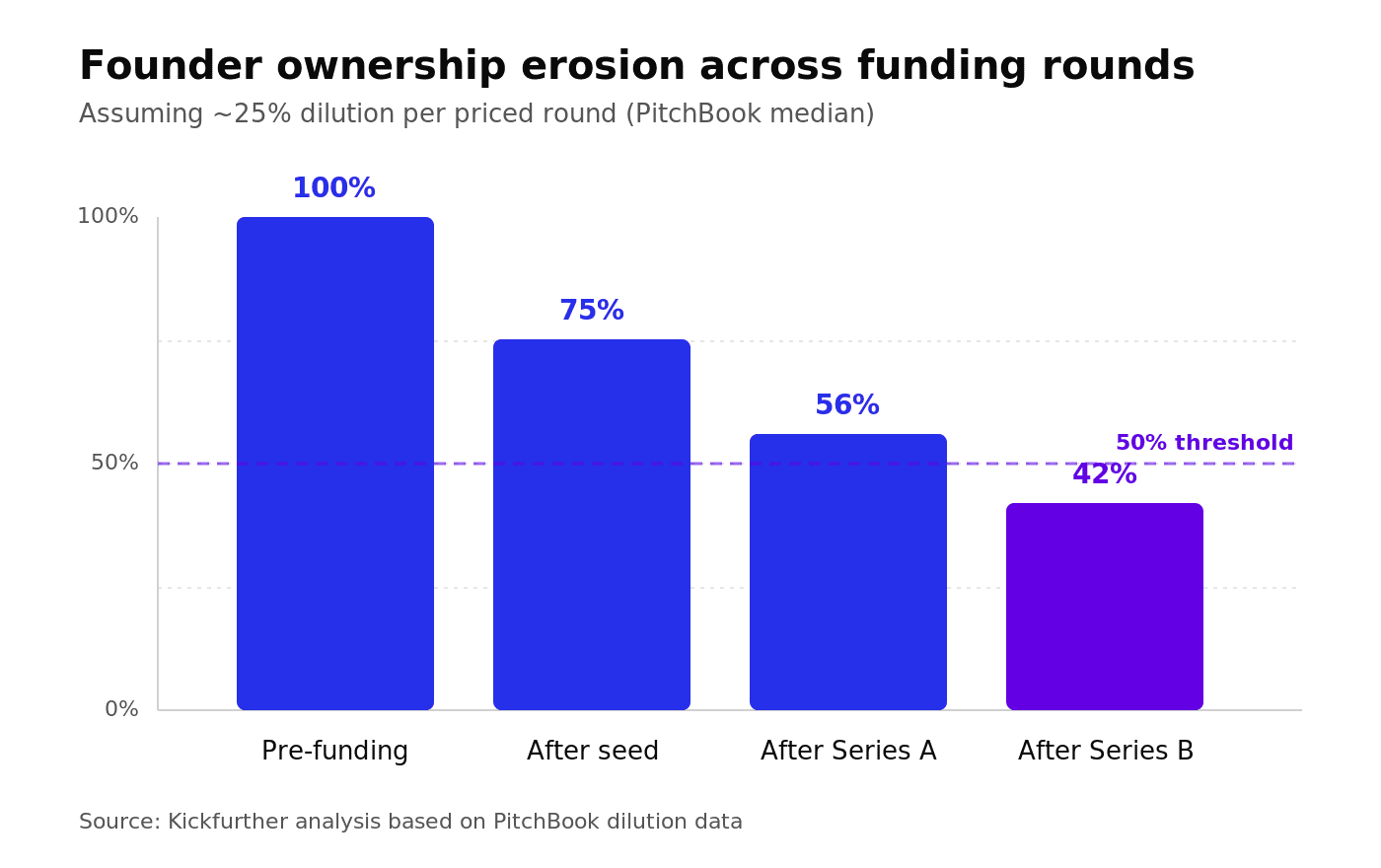
First, the venture market shifted hard after 2022. Deal terms tightened. Down rounds became more common. Founders who raised at peak valuations watched the math get ugly fast. According to data from PitchBook, the median dilution per priced seed round still runs around 20 to 25%. Stack two or three rounds, and a founder’s stake can drop below 50% before the company hits scale.
Second, founders are doing the dilution math more carefully. If you sell 25 percent of your company today to fund a single inventory cycle, you’ve potentially given up 25 percent of every future dollar that company generates, forever. For a CPG brand growing at 30 to 50 percent a year, that math gets painful quickly.
Third, opportunities aren’t waiting. A locked-in retailer order, a 72-hour manufacturer discount, a seasonal restocking window, these don’t pause for an 8- to 12-week venture process or a similarly long bank approval. Founders are reaching for non-dilutive options because the ones that actually fit a CPG business (inventory funding, PO financing, RBF, factoring) close in days or weeks, not months. Capital that arrives after the opportunity has passed isn’t capital at all.
How does non-dilutive financing work?
Non-dilutive vehicles fall into four broad mechanics, and understanding them upfront makes the rest of this guide easier to navigate.
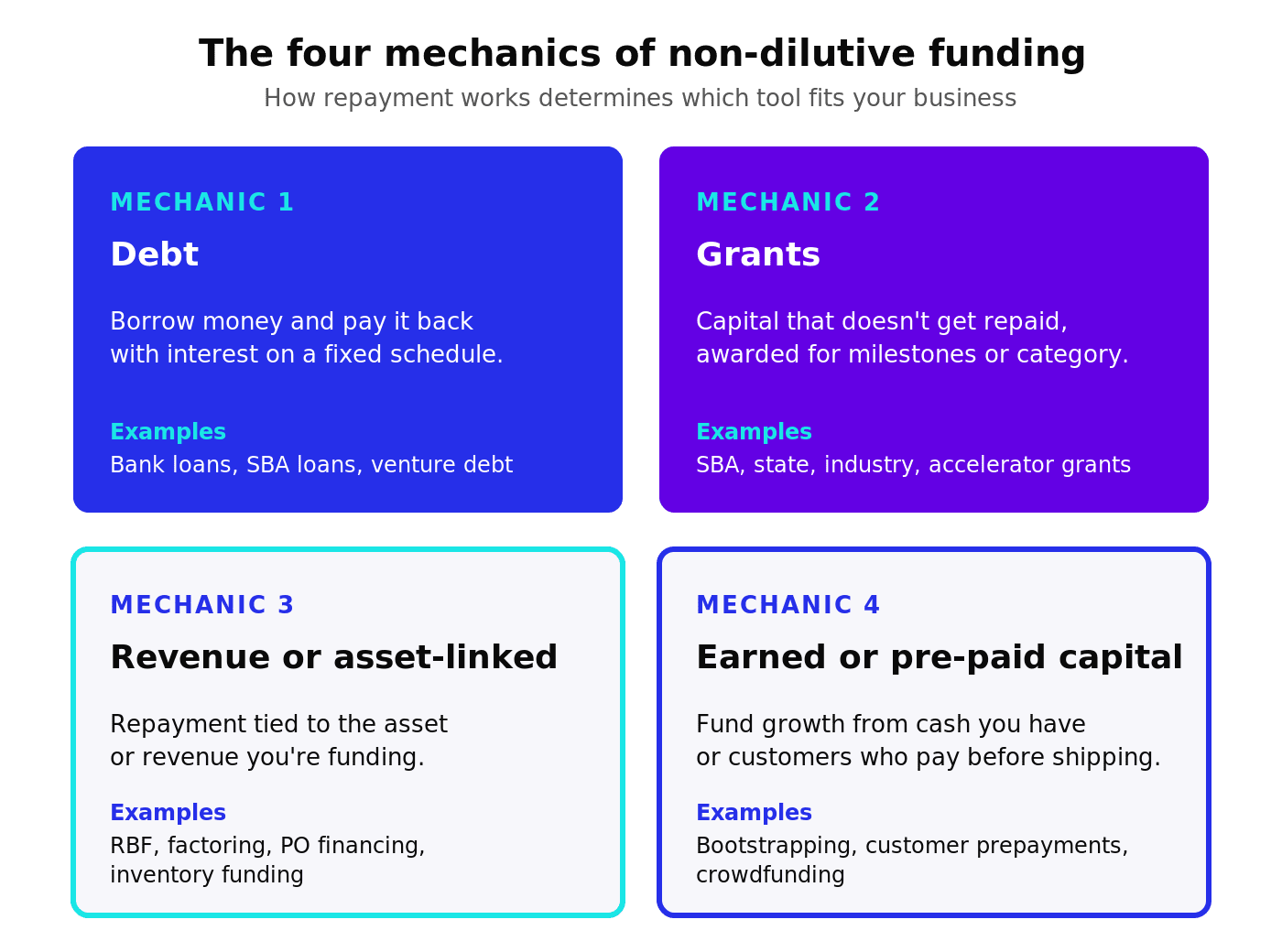
Debt. You borrow money and pay it back, usually with interest, on a fixed or amortized schedule. Bank loans, SBA loans, and venture debt fit here.
Grants. You receive capital that doesn’t have to be paid back, usually provided by the state or federal government or non-profits in exchange for hitting milestones, doing research, or operating in a specific category.
Revenue or asset-linked. Repayment is tied to the asset you’re funding or the revenue it generates. Revenue-based financing, invoice factoring, purchase order financing, and inventory funding all fall here.
Earned or prepaid capital. You fund growth from cash you already have or from customers who pay before you ship. Bootstrapping and rewards-based crowdfunding live here.
The “cost of capital” is the all-in price of the money—interest, fees, rates, equity-equivalent costs, whatever’s baked in. When you’re comparing options, always compare on cost of capital, not just headline rates.
8 types of non-dilutive funding
Here are the eight forms of funding that won’t dilute your stake in the business, including what each one is best for, and where the trade-offs sit.
1. Grants
Grants are capital you don’t repay, usually awarded by governments, foundations, accelerators, or industry groups. The U.S. Small Business Administration lists federal programs. State and local governments run their own. Industry programs exist for sustainability, women-owned businesses, veteran-owned businesses, and specific categories like food and beverage.
Best for: Research-heavy startups, social-impact businesses, specific industry categories
Typical size: $5,000 to $500,000 (some research grants go higher)
Cost of capital: Effectively zero, but the application work is real
Trade-off: Very competitive, slow timelines, often restricted in how funds can be used
2. Venture debt
Venture debt is term debt extended by a specialized capital provider to venture-backed companies, usually after an equity round. The capital provider uses the equity round as a credit signal. Repayment may fixed and amortized or it may operate more like a line of credit.
Best for: Venture-backed companies extending runway between rounds
Typical size: 25 to 35 percent of the most recent equity raise
Cost of capital: Roughly 10 to 15 percent all-in but often also requires warrants (which can cause dilution)
Trade-off: Requires venture backing first, may include warrants, strict covenants
3. Revenue-based financing
Revenue-based financing, or RBF, is capital you repay as a percentage of monthly revenue until a fixed multiple is hit. There’s no fixed monthly payment—when revenue is up, repayment is up; when revenue dips, repayment dips.
Best for: Software, ecommerce, and subscription businesses with predictable monthly revenue
Typical size: 3 to 6 times monthly revenue
Cost of capital: Effective rates often 20 to 40 percent annualized
Trade-off: Usually requires consistent monthly revenue ($15K minimum is common); can be expensive for slow-growing businesses
4. Invoice factoring
Invoice factoring is when you sell unpaid invoices to a factor at a discount in exchange for cash today. The factor collects from your customer when the invoice comes due.
Best for: B2B businesses with creditworthy customers and 30- to 90-day payment terms
Typical size: 70 to 90 percent of invoice value upfront
Cost of capital: 1 to 5 percent of invoice value per month
Trade-off: the factor underwrites your customer, not you. And most factoring agreements restrict what other financing you can take on, so read the covenants before you sign.
5. Purchase order (PO) financing
PO financing advances capital against a confirmed purchase order so you can fulfill the order. The financer pays your supplier directly, then gets repaid when your customer pays you.
Best for: Businesses with a confirmed PO from a creditworthy buyer but not enough cash to produce
Typical size: Up to 100 percent of supplier costs
Cost of capital: 1.5 to 6 percent per month of PO value
Trade-off: Requires a verifiable PO from a strong buyer; doesn’t solve broader cash flow, may cause friction in the relationship with PO-issuer or signal weakness to them.
6. Inventory funding
Inventory funding is capital tied directly to an inventory order. Several vehicles fit here—asset-based loans, traditional inventory loans, and consignment-style marketplace models.
This is the lane we work in, so I’ll be direct about how Kickfurther approaches it. On our marketplace, brands fund up to 100 percent of an inventory order upfront. Payments begin as inventory sells. We structure it as a consignment model rather than a traditional loan structure. Many brands use Kickfurther to access inventory capital without taking on traditional term debt.
How Kickfurther helps
Kickfurther uses a consignment funding model designed specifically for inventory-heavy consumer brands. A CPG brand with proven sell-through can fund a full production cycle on the Kickfurther marketplace. Kickfurther is designed to move faster than many traditional financing processes, and payments are tied to actual inventory sales, meaning the payment structure more closely aligns with the cash-flow realities of CPG brands rather than a bank’s fixed monthly payment obligations.
Best for: CPG brands with proven sell-through, inventory-heavy businesses, founders protecting equity and personal assets
Typical size: $150,000 average Co-Op size
Cost of capital: Co-Op costs vary by structure and sales expectations and include a funding fee structure that varies based on the opportunity and sales expectations.
Trade-off: Designed for physical-product businesses; not a fit for software or services
7. Crowdfunding (rewards-based)
Rewards-based crowdfunding (Kickstarter, Indiegogo) is when supporters pre-pay for a product before it ships. You’re effectively selling future inventory at a discount in exchange for early cash.
Best for: New product launches, brands with a strong story, consumer products with broad appeal
Typical size: $10,000 to $1M+ per campaign
Cost of capital: Platform fees (5 to 8 percent) plus payment processing
Trade-off: Requires marketing horsepower; you owe product to backers regardless of how production goes, often make little to no profit for initial inventory run.
8. Bootstrapping and customer prepayments
Bootstrapping is funding growth from operating cash flow. Customer prepayments—annual contracts, deposits, retainers—are a close cousin. Both keep your cap table completely clean.
Best for: Profitable businesses, service businesses, businesses with leverage to ask for prepayment
Typical size: Whatever your business generates
Cost of capital: Zero, plus the opportunity cost of slower growth
Trade-off: Caps growth speed; can leave you exposed if a major opportunity needs more capital than you have on hand, usually requires recycling almost all free cash back into the business in lieu of taking a paycheck.
Benefits of non-dilutive capital
Here’s what founders actually get when they choose non-dilutive options:
- You keep your equity. Every share you don’t sell today is a share you can sell later—at a higher valuation, in a more competitive process, or never at all if you’d rather hold.
- You keep decision-making control. No board seats, no investor approval rights on key decisions, no quarterly reporting cycles aimed at hitting a venture-style growth curve.
- You can match the capital to the use case. Inventory cash for inventory cycles, grant money for R&D, factoring for receivable gaps. Equity is one-size-fits-all; non-dilutive is tailored.
- The right vehicle aligns with your cash cycle. A well-structured non-dilutive option aligns payments with when the business generates sales. That’s especially true for revenue-linked and inventory-linked structures.
- You protect personal assets when the structure allows. Some non-dilutive options (Kickfurther included) come with no personal guarantees. Others (most bank loans) still require them, so read the terms.
Trade-offs and benefits of non-dilutive funding
Non-dilutive isn’t a free lunch. The honest trade-offs:
- Funding costs can run higher than equity in any single period. Equity is “expensive” in the long run because of dilution, but the in-period cash cost can be lower than RBF, factoring, or merchant cash advances.
- Eligibility is real. Most non-dilutive vehicles need revenue history, time in business, or a specific asset (a PO, inventory, an invoice) to anchor the deal. Pre-revenue startups have fewer options.
- Some structures still require personal guarantees. Traditional bank loans, SBA loans, and many venture debt deals do.
- Timing mismatches happen. A revenue-based financing deal with monthly amortizing repayments can choke a CPG brand whose cash comes in seasonally. Match the repayment shape to your cash-flow shape.
| Dilutive (equity) | Non-dilutive | |
|---|---|---|
| In-period cash cost | Lower | Variable |
| Long-term cost | High (forever-dilution) | Bounded |
| Founder control | Reduced (board, votes) | Preserved |
| Speed to close | Months | Days to weeks |
| Eligibility | Story-driven | Revenue/asset-driven |
| Repayment | None | Required (most types) |
Is non-dilutive funding right for your business?
I use a four-question framework with founders trying to decide:
- Do you have revenue, an asset, or a PO to anchor a deal? If yes, non-dilutive options open up. If no, equity or grants are usually the path.
- What are you funding? Capital should match the use case. Inventory cycles want inventory funding. R&D wants grants or venture money. Marketing experiments want flexible capital like RBF or a line of credit.
- How sensitive are you to dilution? If you’ve already given up 30 to 40 percent across earlier rounds, the case for non-dilutive going forward gets very strong.
- What’s your timing? If you need capital in 30 days, equity is rarely the answer. Most non-dilutive vehicles can close faster.
There are still cases where equity is the right call—high-burn, pre-revenue, deeply technical businesses where the company can’t generate cash for years. The point isn’t to avoid equity at all costs. It’s to avoid using equity for things non-dilutive options can fund.
How to choose the right non-dilutive financing option
Once you’ve decided non-dilutive makes sense, the next question is which one. Here’s the rough decision tree I’d walk through:
- R&D-heavy or scientific work → Grants first, then venture debt if you’ve raised already
- Software / SaaS with monthly revenue → Revenue-based financing
- B2B with slow-paying customers → Invoice factoring
- Confirmed PO you can’t fulfill → Purchase order financing
- CPG / physical-product brand needing inventory → Inventory funding
- New product launch with audience → Rewards-based crowdfunding
- Profitable, just need to manage timing → Bootstrapping with disciplined cash management
For CPG and inventory-heavy businesses, the common cash-flow gap goes like this: production takes 3 to 5 months, distributor payment terms run 60 to 90 days, and a bank will fund maybe 50 percent of the order if they fund it at all. That math doesn’t work for a growing brand.
That gap is the reason we built Kickfurther the way we did. On our marketplace, brands can secure up to 100 percent of an inventory order upfront, make payments as inventory sells, and don’t sign a personal guarantee. It’s not the right tool for every business—but for a CPG brand fighting the inventory-cash mismatch, it’s purpose-built.
“Kickfurther was the perfect inventory capital solution to allow us to keep up with rapidly increasing demand for our products. The Kickfurther team has been wonderful to work with and has made the funding process seamless—it’s been pivotal to our success.
— Heide Iravani & Emily Clifford, Co-founders, Piccolina
Frequently asked questions
Is non-dilutive funding the same as a loan?
No. A loan is one form of non-dilutive funding, but the category is broader. Grants, revenue-based financing, factoring, inventory funding through a consignment-based inventory model like Kickfurther, and rewards-based crowdfunding all qualify as non-dilutive—and most of them aren’t structured as loans.
What’s the difference between non-dilutive and dilutive funding?
Dilutive funding (priced equity rounds, convertible notes, SAFEs) gives investors ownership in your company in exchange for capital. Non-dilutive funding doesn’t. The trade-off typically comes through fees, payment timing, qualification requirements, or operational obligations rather than ownership dilution.
Can early-stage startups qualify for non-dilutive funding?
Some non-dilutive options are open to early-stage startups, but the menu is narrower. Grants, accelerators, rewards-based crowdfunding, and customer prepayments are usually accessible pre-revenue. Most other non-dilutive vehicles require revenue history, a confirmed purchase order, or an asset to anchor the deal.
Is non-dilutive funding cheaper than venture capital?
It depends on the time horizon. In any single period, equity has no cash cost. Over the life of the company, equity is usually the most expensive form of capital because dilution compounds across rounds. Non-dilutive vehicles charge cash today but don’t chip away at your ownership. For most CPG founders, the long-term math favors non-dilutive.
Do I need revenue to qualify for non-dilutive funding?
For most types, yes. Revenue-based financing, factoring, and most inventory consignment models need at least some revenue history. Exceptions include grants, accelerator awards, and rewards-based crowdfunding, which can work pre-revenue.
What types of businesses benefit most from non-dilutive funding?
Inventory-heavy CPG brands, profitable software companies, B2B businesses with slow-paying customers, and brands with strong audiences and new products to launch. The common thread is having something concrete (revenue, inventory, a PO, an audience) to anchor the deal.
Is government grant money truly non-dilutive?
Yes. Federal, state, and local grants often don’t take equity and don’t require repayment when the terms are met. The catch is restrictions on use, milestone reporting, and competitive application processes. Read the conditions carefully.
Can you combine non-dilutive funding with equity financing?
Yes, and most well-capitalized companies do. Equity for the things only equity can fund (long R&D timelines, high-burn periods), non-dilutive for the things non-dilutive does well (inventory, receivables, revenue-tied growth). The point is to use each tool for what it’s built for.
How does Kickfurther’s inventory funding work for a CPG brand?
A CPG brand creates a Co-Op on the Kickfurther marketplace, describing the inventory order—units, supplier, sales channels. Kickfurther facilitates consignment opportunities that help brands secure inventory upfront. The brand uses the funds to produce or purchase inventory, sells through their channels, and pays as inventory sells. Many brands use Kickfurther to align inventory payments more closely with sales cycles while keeping working capital available for growth.
How fast is non-dilutive funding compared to a bank loan?
Most non-dilutive options close faster than a traditional bank loan. Bank approval can take six to twelve weeks for a small business. RBF, factoring, PO financing, and marketplace inventory funding (Kickfurther included) typically close in days to a few weeks. Speed is one of the bigger reasons founders choose non-dilutive when an opportunity is time-sensitive.