TL;DR
- Inventory crowdfunding lets a business fund a specific inventory purchase through a marketplace of buyers, instead of a single institutional lender.
- It exists to close a common cash-flow gap: suppliers want payment up front, but only 52 percent of small business loan applicants get approved for the full amount they ask for, per the Federal Reserve.
- No equity given up and payments tied to sales, but usually a higher cost of capital than a bank loan.
- It’s faster than a bank or SBA loan and leans on sales history rather than years of credit history.
- Kickfurther runs on a similar model where a business sets a funding goal, buyers fund it on consignment, and payment follows as the inventory sells.
Running a business requires disciplined cash flow management. But when demand is growing, cash isn’t always readily on hand. Inventory crowdfunding is a fast and effective way to keep products stocked and selling. When a business can’t cover its costs or secure enough inventory to meet demand, it can lead to debt or, in the worst case, business failure.
Businesses today have more ways than ever to close that gap. From online loans to inventory funding through Kickfurther’s marketplace. This article covers what inventory crowdfunding is, how it compares to traditional loans, and which option is best for a business at any stage.
What is inventory crowdfunding?
Quick answer
Inventory crowdfunding is a way for businesses to fund inventory through a marketplace of individual buyers rather than a single lender. It’s an inventory financing alternative that differs from a traditional loan. A business sets a funding goal tied to a purchase, buyers fund it collectively, and the business pays out as that inventory sells.
It’s one specific type of inventory financing. The broader category that also includes bank loans, lines of credit, and supplier financing.
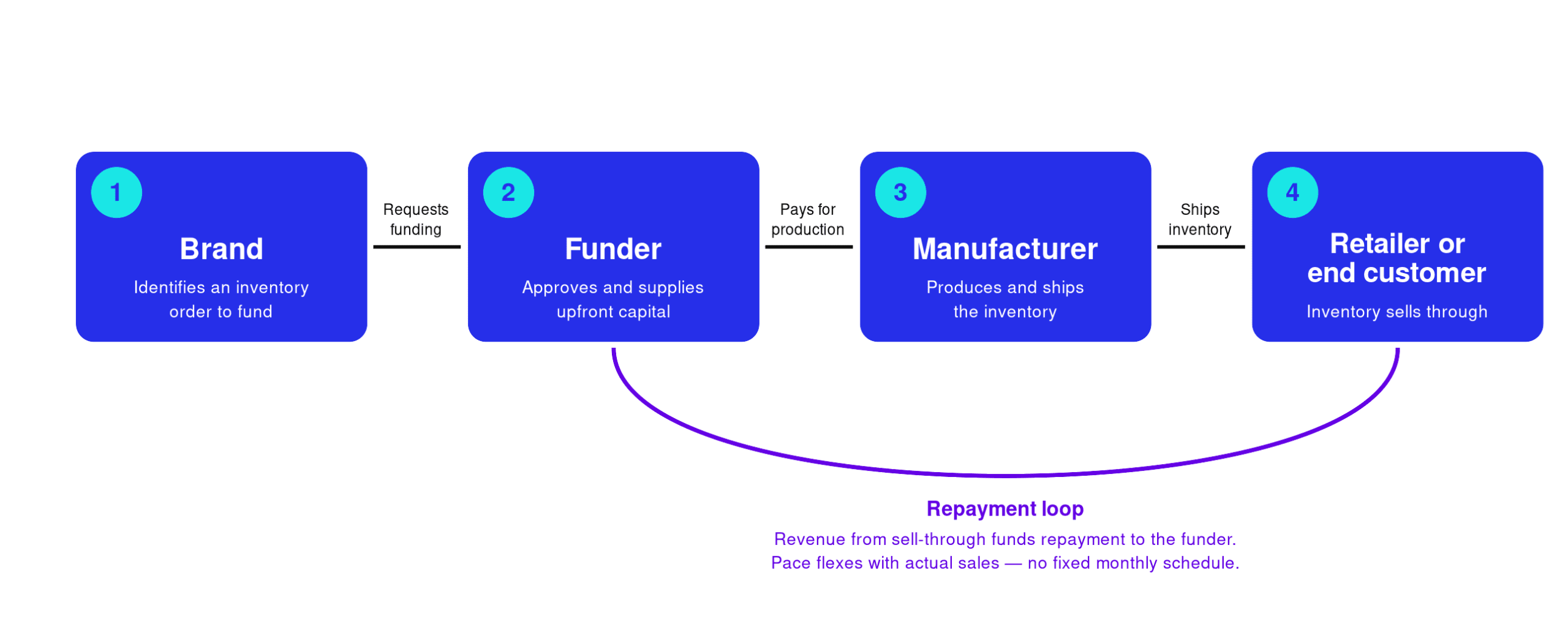
How inventory crowdfunding on consignment works:
- A business applies and shares its sales history, so the marketplace can gauge how well the inventory is likely to sell.
- The business sets a funding goal tied to a specific purchase—usually a production run or a bulk supplier order.
- Individual buyers commit funds toward that goal.
- Once the goal is met, the funds go toward purchasing the inventory.
- As the business sells that inventory, it makes payments, distributed to buyers who funded it, plus the marketplace’s cost of capital, until the balance is paid off.
What are the different types of crowdfunding?
Crowdfunding means raising money from a crowd of individual backers rather than a single lender or investor, and it comes in a few crowdfunding types.
- Donation-based crowdfunding (the GoFundMe model) asks supporters to contribute money toward a cause, with no expectation of anything in return.
- Rewards-based crowdfunding (the Kickstarter and Indiegogo model) offers backers a reward, usually the product itself, in exchange for supporting it before it’s built.
- Equity crowdfunding offers backers a small ownership stake in the business in exchange for capital, with no debt component.
- Debt and revenue-based crowdfunding is the category inventory crowdfunding sits in, closer in spirit to what consignment financing is than to a Kickstarter campaign. It pays a marketplace of individual buyers over time, with payments tied to sales rather than a fixed schedule.
Crowdfunding is often used by small to medium-sized businesses and nonprofit organizations to finance a new business venture, expand a brand’s product line, or raise money for a charitable cause.
Why do brands need inventory funding?
The cash flow gap
Suppliers typically want payment, or at least a deposit, up front, while retail and ecommerce customers often pay 30, 60, or 90 days out. Only 52 percent of small business applicants get approved for the full amount of financing they seek, according to the Federal Reserve‘s 2026 Main Street Metrics report.
Startups and early-stage CPG brands feel this most, since they often haven’t built the credit history a bank wants to see. Established brands hit the same wall when preparing for their first large retail order—which is why ecommerce financing options built around this gap have grown alongside the industry.
Growth is adding to the pressure
Per Deloitte‘s 2026 Global Consumer Products Industry Outlook, seven in ten executives expect high growth opportunities beyond their traditional markets, supported by expanded distribution, digital capabilities, and ecommerce.
Two-thirds of surveyed organizations plan to grow through partnerships, and about half intend to rationalize SKUs. Both of which mean committing capital to inventory earlier.
How Kickfurther helps
This is the gap Kickfurther was built to close. Instead of waiting on a bank loan or draining cash reserves to cover a supplier’s payment terms, a Brand can fund a specific inventory purchase through a community of buyers. Buyers purchase product up front, and the brand pays out as inventory sells, on a consignment basis. No equity given up, no due diligence process measured in months.
“Kickfurther was the perfect inventory financing solution to allow us to keep up with rapidly increasing demand for our products. The Kickfurther team has been wonderful to work with and has made the funding process seamless—it’s been pivotal to our success.
— Heide Iravani & Emily Clifford, Co-Founders, Piccolina
Piccolina funded over $1.5 million in inventory needs across 16 Co-Ops through Kickfurther. The results: Sales grew 10X, profit margins rose 12 percent, and customer retention improved 3X since.
Pros and cons of inventory crowdfunding
Here’s the full scope of what to expect from inventory crowdfunding.
Advantages:
- No equity given up. Unlike equity financing or an investor check, funding a purchase this way doesn’t cost a founder ownership.
- Faster than a traditional loan. Funding can move in days to weeks, without a bank’s due diligence process.
- Payment tied to sales. Payments flex with how the inventory actually sells, instead of a fixed monthly bill.
- Doesn’t require a long credit history. It leans more on sales data than years of financial history.
Disadvantages:
- Higher cost of capital than a bank loan. Speed and flexibility usually cost more than a bank’s interest rate.
- The funding is tied to one inventory purchase. If inventory sales fall well short of projections, it affects both the payouts and the business’s standing with the marketplace.
- Cash flow strain if sales are slower than expected. A slow launch delays payment either way.
- Not every business qualifies. Marketplaces want to see proven sales velocity, so pre-revenue brands and unproven SKUs are usually screened out.
Inventory crowdfunding vs traditional loans
| Financing option | Payment | Collateral required | Typical speed | Best for |
|---|---|---|---|---|
| Traditional bank or SBA loan | Fixed monthly payments | Usually yes | Weeks to months | Established businesses with strong credit history |
| Business line of credit | Draw and repay as needed | Sometimes | Days to weeks | Ongoing, recurring working capital needs |
| Online/alternative business loans | Fixed short-term payments | Sometimes | Days | Businesses that need cash fast and can accept a higher rate |
| Merchant cash advances | A percentage of future card sales | None | Days | Businesses with high, consistent card sales volume |
| Angel investment | Equity, not repayment | None | Weeks to months | Early-stage businesses willing to give up ownership |
| Supplier or purchase order financing | Paid from the resulting sale | The purchase order itself | Days to weeks | A specific, confirmed order |
| Inventory crowdfunding | Payments tied to sales, distributed to buyers who funded purchase | Usually the inventory itself (not outside assets) | 1–2 weeks | Product businesses funding a specific inventory purchase |
A traditional bank loan, or a loan backed by the U.S. Small Business Administration, typically offers the lowest cost of capital. Along with a business inventory line of credit, it also comes with the most friction: a time-consuming due diligence process, several years of financial history, and often a personal guarantee or collateral beyond the inventory itself.
Inventory crowdfunding sits closest to supplier and purchase order financing. The capital is tied to a specific purchase, and payments depend on how that inventory sells. What sets it apart is the funding source: a marketplace of individual buyers rather than a single lender, which tends to make it faster to access.
What are the requirements to qualify for inventory financing?
How can you get funding for inventory? A lender or marketplace wants to see that a product already sells, not just that it could. Recent sales data, a repeat purchase pattern, or a confirmed retail order all help. Businesses are expected to show strong sales performance before a funding option is available.
Credit history still plays a role for traditional options like bank loans and lines of credit, though it carries much less weight for financing tied to a specific purchase order. Expect questions about the supplier relationship, production timelines, and what collateral—often the inventory itself—backs the funding.
How to apply for inventory financing:
- Gather sales history, supplier quotes, and production timelines for the purchase in question.
- Decide how much capital you actually need. Funding more than the confirmed order tends to slow approval down.
- Apply with a lender or marketplace suited to the size and type of financing you’re after.
- Share supporting documentation quickly; back-and-forth on paperwork creates delays.
- Compare the cost of capital across the options you’re approved for before accepting one.
How Kickfurther approaches inventory funding
Kickfurther’s marketplace bridges this gap by relieving the cash crunch felt by brands in the time after they’ve purchased inventory but haven’t yet collected the cash from selling it. We connect brands to a community of buyers who fund inventory on consignment through a Consignment Opportunity (Co-Op). This gives brands the flexibility to pay out as they collect cash from sales, without the rigid repayment schedule a traditional lender requires.
How Kickfurther works:
- A Brand shows its sales performance during a vetting process. Once approved, it can open a Co-Op for a specific inventory purchase.
- Before the Co-Op goes live, the Brand sets the Co-Op details, including production timeline, estimated sales, and payout dates.
- Buyers purchase the inventory on the business’s behalf.
- As the inventory sells, the Brand makes payments on the agreed payout dates, and Buyers earn consignment income.
Your equity stays intact, with payments tied to how the inventory actually performs.
“With a traditional MCA, it felt like a loan from someone who isn’t fully invested in what you were building. Kickfurther is the opposite. They understand CPG, including the POs, the receivables, the timing. And my Kickfurther funding experts made us feel like they were on our team long before we qualified for our first Co-Op. That and the flexibility is why we keep coming back.
— Sai Svoboda, Co-Founder & Co-CEO, Drink Hippie
Drink Hippie funded $212,198 across three Co-Ops through Kickfurther. The results: roughly 400 independent retailers nationwide and an 83 percent reorder rate on Hippie Energy.
Choosing the right inventory financing option for your business
There’s no single best option—it depends on a handful of factors specific to the business and the purchase it’s funding:
- Growth stage: A newer business with limited credit history usually has more luck with financing tied to sales than with a traditional bank loan.
- Cost-of-capital tolerance: Traditional loans offer the lowest cost of capital; speed and flexibility come at a somewhat higher cost.
- Collateral available: Options tied to the inventory itself, or to a confirmed purchase order, don’t require the broader collateral a bank wants.
- Speed needed: A business chasing a launch date usually can’t wait out a traditional loan’s due diligence process.
- Willingness to give up ownership: Equity crowdfunding and angel investment trade capital for a stake in the business. Inventory crowdfunding doesn’t.
Whichever option a business chooses, the goal is the same: capital that lines up with how the business actually gets paid. For a closer look at Kickfurther’s inventory funding model, explore Kickfurther’s marketplace directly.
FAQs
Can an LLC use crowdfunding for inventory?
Yes. Inventory crowdfunding is available to LLCs, corporations, and other registered business entities—it’s a business-financing tool, available to most brands who want to finance inventory. Most marketplaces will still want to see sales history and a specific inventory purchase behind the request, regardless of entity type.
How hard is it to get a large business loan to finance your inventory?
It depends heavily on the size of the request and the business’s financial history. Larger loan amounts typically mean more documentation, a longer due diligence process, and a higher bar for credit history and collateral. Many younger or fast-growing businesses find it faster to fund a large purchase through financing tied to sales, like inventory crowdfunding, than to wait on a large traditional loan.
Is inventory crowdfunding the same as an inventory loan?
No. A traditional loan comes from a single lender, carries a fixed interest rate, and is repaid on a fixed schedule regardless of how a business’s inventory sells. Inventory crowdfunding is funded by a marketplace of individual buyers, and payouts are tied to actual sales performance rather than a fixed bill.
How much does inventory financing cost?
Cost varies by type of financing. Traditional bank loans usually carry the lowest cost of capital but the strictest qualification requirements. Options tied to sales performance or a specific purchase order—including inventory crowdfunding—typically price the funding as a flat cost of capital instead of a fixed interest rate, and that cost reflects the speed and flexibility of the funding.
Can a new business or startup get inventory financing?
Yes, though options narrow somewhat for businesses without an established credit history. Financing tied to sales performance or a confirmed purchase order tends to be more accessible to newer businesses than a traditional bank loan, since it leans less on years of financial history and more on how well a specific batch of inventory is likely to sell.
What happens if you can’t repay inventory financing?
The consequences depend on the type of financing. A traditional loan that goes unpaid can affect a business’s credit history and put any pledged collateral at risk. Financing tied to sales, like inventory crowdfunding, is structured around the inventory actually selling, so what happens if sales fall short is set out in the agreement before funding starts. Read those terms closely before you sign.
Do you need collateral for inventory financing?
It depends on the option. Traditional bank loans or a line of credit often require collateral beyond the inventory itself. Financing tied to a specific purchase—supplier financing and purchase order financing—typically uses the inventory or the purchase order itself rather than additional assets. Consignment-based funding works differently again, in that the funding is tied to the inventory purchase, not secured against a business’s outside assets.
Note: This post was originally published on Oct 12, 2021. It was updated and republished on Sept. 18. 2026.